

Transport robots
On the way to intelligent, autonomous transport robots
The development continues: the smart, automated production of the future will require transport robots that have capabilities such as autonomous route planning and people recognition, are capable of learning and can "think for themselves". EK Robotics, a supplier of AGVs on the European market, is involved in numerous current research projects.
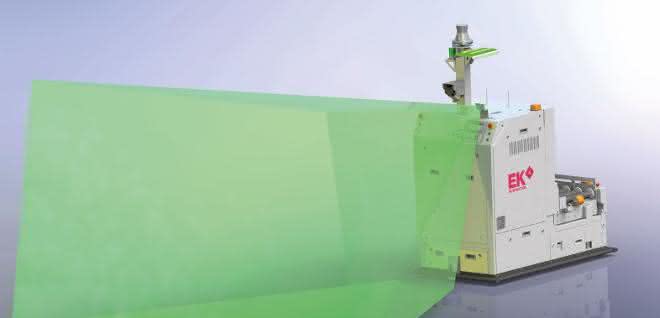
How can deformable loads with non-uniform dimensions be safely picked up, transported and stacked automatically? This was the question behind the POS3D project, which EK Robotics developed together with a customer. The specialist in transport robotics used 3D cameras in conjunction with innovative image analysis software. A depth camera, attached to the autonomous transport robot, captures the load to be transported and records the distance of each individual pixel. The data is collected in a point cloud and evaluated in real time by software developed by EK Robotics. Thanks to highly precise calculations, the AGV is now able to recognize the exact type and position of transported goods and to guide them with millimetre precision. The use of 3D camera technology thus makes automated logistics processes possible even for unstable and deformable products of non-uniform heights. The pilot project, tested by transporting empty PET containers, confirmed the process reliability of this technology. It is now available to all EK Robotics customers.
VDA 5050 - Standard interface is here
VDA 5050 is a universally applicable interface description that will simplify the connection of different automated guided vehicles to an existing control system in an existing automated guided vehicle system in the automotive industry.
The initiators are the VDA (German Association of the Automotive Industry) and the VDMA (German Engineering Federation / Materials Handling and Intralogistics Association). A collaborative project team consisting of these same associations, AGV users and AGV manufacturers, including EK Robotics, has been working on the development of this new guideline since mid-2017. The aim is to enable the operation of automated guided vehicles from different manufacturers in the same working environment. Jan Drömer, CIO at EK Robotics and head of the "Automated Guided Vehicles" department at the VDMA, explains: "The first part of the results of this work has already been published. Once completed, the VDA 5050 standard interface will then be implemented for the AGVs from EK Robotics."
More planning reliability with a "digital twin"
Since the beginning of 2020, EK Robotics has been researching the development of a digital AGV twin in a cooperation project with Leuphana University Lüneburg. It involves the creation of a "digital twin" of a customer environment for which an AGV is to be designed in a 3D point cloud. "The aim of this project is to use a 3D point cloud to create an identical virtual twin of the system environment, which can be used to automatically identify objects such as systems or racks in the room and recognize routes. The AGV is then tested virtually in the digital model," explains Jan Drömer. In this way, all production and logistics processes are run through before the actual commissioning. Load cycles are simulated in advance and challenges are identified. "We have been working with simulations for a long time, but commissioning can be carried out more efficiently with the help of an identical digital image of the customer's environment," says the expert from EK Robotics.
Lightweight robotics in aircraft construction
Another step towards autonomous transport robotics is the Commands 2 project, funded by the state of Lower Saxony. The project team, consisting of Airbus, Axios 3D Services, Broetje Automation, EK Robotics, Fraunhofer IFAM, Premium
Aerotec and SWMS Digital Innovations, is working on the development of a lightweight robotics toolbox for aircraft assembly. This so-called cobot, i.e. a collaborative robot that is allowed to work with human colleagues without a separating protective device, is intended to support employees in work steps such as riveting, drilling and grinding. In this project, EK Robotics has taken on the development of the mobile platform for the lightweight robot. This should be capable of navigating in dynamic environments and have 360° obstacle collision monitoring. To this end, EK Robotics is providing the corresponding interfaces for augmented reality (AR) and robotics. Karsten Bohlmann, Head of Research & Development, explains: "You have to see these cobots as part of an overall system: An entire fleet of these robots could be used to plan an optimal route for the production of the future."
"Intuitive-nonverbal and informative-verbal robot-human communication" - this is the objective of the Intuitiv project launched in mid-2018, funded by the Federal Ministry of Education and Research, in which EK Robotics is participating and acting as the project coordinator. Together with the project partners, the German Research Center for Artificial Intelligence (DFKI), Gestalt Robotics and HFC Human-Factors-Consult, EK is developing an assistance robot to support care staff in the rehabilitation sector. For example, it will be used to transport luggage and goods, guide patients from reception to their rooms and guide them interactively through the clinic.
EK Robotics is responsible for developing the transport platform. "Its technology is based on the further development of the Fast Move, our ultra-flat and compact transport robot." However, Karsten Bohlmann also sees great demand potential for the content of the other research projects, which mark milestones on the way to autonomous transport robots: "With the 3D camera technology we have implemented, processes that could not previously be automated can now be automated. This offers AGV users new opportunities to save costs and increase their competitiveness."


You might also be interested in
Outdoor AGV networks production and logistics
An international company in the plastics industry is automating its intralogistics at its German site with a solution from ek robotics. A specially developed vehicle model from the Out Move series, an outdoor AGV, is being used.
 read more...
Transport systems for automated material flow
The Leo transporters from Bito make it easier for users to get started with the automation of material processes, which is possible from 20,000 euros. The system is a flexible all-in-one complete solution that is ready for immediate use and can be...
read more...Automated logistics for the university hospital
As part of the new construction of the University Hospital of Reims (CHU), France, the hospital has taken a number of steps to improve the needs of its patients and the working environment of its employees.
read more...K.Hartwall: Topping-out ceremony for the German site
The topping-out wreath was raised at the new building in the TIP Innovationspark Nordheide in Buchholz near Hamburg on February 27: The new K.Hartwall plant will comprise approx. 3,500 m² of hall space and around 2,000 m² of office and social areas.
read more...Noerpel Group tests driverless high lift trucks
The Noerpel Group has tested driverless pallet trucks in one of its two logistics facilities in Giengen. During a four-week trial, two autonomous systems were used to transport goods within the warehouse.
read more...Supply and disposal of printing machines by AGV
Numerous companies rely on AGVs in intralogistics to increase efficiency and meet challenges such as the shortage of skilled workers. One such company is GGP Media GmbH in Pößneck, Thuringia.
read more...Sophisticated automation: AGV and cobot combined
On behalf of Krefeld-based Saurer Technologies, the engineering team from Project Automation & Consulting developed a solution for production logistics that combines AGVs and cobots.
read more..."Herbie" robot in the Körber portfolio
Carrybots, a specialist in mobile robotics, is a new partner in the Körber supply chain ecosystem. The aim of this collaboration is to strengthen the position of both companies in intralogistics. Herbie" enables robot-based goods-to-person processes.
read more...Demand-oriented load carrier transport
Efficient logistics with AGVs
Environmental awareness and the careful use of resources are becoming increasingly important. With advanced solutions, plant operators can significantly improve the ecological footprint of logistics processes.
read more...