

VDA 5050 is the code word
Interface for automated guided vehicles passes practical test
The manufacturer-independent networking of automated guided vehicles has taken a major step forward. Six companies jointly tested the VDA 5050 interface with their vehicles at the AGV Mesh-Up.
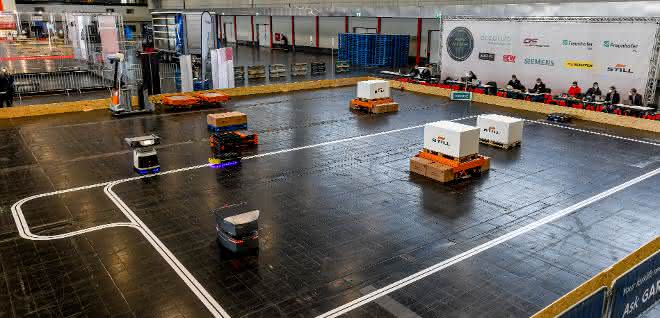
The event was part of this year's TEST CAMP Intralogistics of the IFOY Award. Production under Industry 4.0 conditions requires smooth communication between machines. This also applies to driverless transport vehicles from different manufacturers that are used in the internal material flow. Standardized communication between these vehicles is significantly simplified by VDA 5050. The communication interface makes it possible to combine different vehicles under any control system using a standardized data language. During the first live test in Dortmund, vehicles from arculus, DS Automotion, Safelog, Siemens AG, SSI Schäfer and Still drove together in a KION Group control system. "This was the first major practical test for the interface to show how the transmission of orders and status data via VDA 5050 works. The test scenario in Dortmund ran reliably over four days and the companies involved were able to try out different details for the vehicles. We are already thinking about continuing the AGV Mesh-Up," explains Andreas Scherb, responsible for the Automated Guided Vehicles department at the VDMA Materials Handling and Intralogistics Association.
VDA 5050 is available with the revision number 1.1. and represents the current interim status. In future, a further version will also describe the assured compatibility of PLC-based automated guided vehicle systems. The so-called AGV Mesh-Up from the VDMA Materials Handling and Intralogistics Association celebrated its world premiere at the IFOY AWARD as part of the TEST CAMP Intralogistics in Dortmund. The name is based on a mesh WLAN, in which different components interlock and are seen as a uniform WLAN. For the vehicles, this means that they drive with different types of navigation (e.g. line-guided or contour-based), but communicate with the higher-level control system in a common data language.
Background
The interface project was realized by a team of AGV users and AGV manufacturers under the coordination of the German Association of the Automotive Industry (VDA) and the VDMA Materials Handling and Intralogistics Association. The aim is to enable automated transport vehicles, such as tugger trains, AGVs or mobile robots, to interact with each other via the master control system using plug-and-play, regardless of the manufacturer or system.


You might also be interested in
Outdoor AGV networks production and logistics
An international company in the plastics industry is automating its intralogistics at its German site with a solution from ek robotics. A specially developed vehicle model from the Out Move series, an outdoor AGV, is being used.
 read more...
Transport systems for automated material flow
The Leo transporters from Bito make it easier for users to get started with the automation of material processes, which is possible from 20,000 euros. The system is a flexible all-in-one complete solution that is ready for immediate use and can be...
read more...Automated logistics for the university hospital
As part of the new construction of the University Hospital of Reims (CHU), France, the hospital has taken a number of steps to improve the needs of its patients and the working environment of its employees.
read more...K.Hartwall: Topping-out ceremony for the German site
The topping-out wreath was raised at the new building in the TIP Innovationspark Nordheide in Buchholz near Hamburg on February 27: The new K.Hartwall plant will comprise approx. 3,500 m² of hall space and around 2,000 m² of office and social areas.
read more...Noerpel Group tests driverless high lift trucks
The Noerpel Group has tested driverless pallet trucks in one of its two logistics facilities in Giengen. During a four-week trial, two autonomous systems were used to transport goods within the warehouse.
read more...Supply and disposal of printing machines by AGV
Numerous companies rely on AGVs in intralogistics to increase efficiency and meet challenges such as the shortage of skilled workers. One such company is GGP Media GmbH in Pößneck, Thuringia.
read more...Sophisticated automation: AGV and cobot combined
On behalf of Krefeld-based Saurer Technologies, the engineering team from Project Automation & Consulting developed a solution for production logistics that combines AGVs and cobots.
read more..."Herbie" robot in the Körber portfolio
Carrybots, a specialist in mobile robotics, is a new partner in the Körber supply chain ecosystem. The aim of this collaboration is to strengthen the position of both companies in intralogistics. Herbie" enables robot-based goods-to-person processes.
read more...Demand-oriented load carrier transport
Efficient logistics with AGVs
Environmental awareness and the careful use of resources are becoming increasingly important. With advanced solutions, plant operators can significantly improve the ecological footprint of logistics processes.
read more...