

AGVs and robotics
Driverless to the test bench
AGV specialist MLR has implemented an automated guided vehicle system at Deutz AG's Cologne-Porz plant within a very short space of time. Although the new automated vehicles travel at 0.6 m/s slower than their predecessors, the MLR AGVs achieve a higher throughput rate.

The independent engine manufacturer Deutz, headquartered in Cologne, specializes in diesel engines in a wide range of performance classes. The engines are primarily installed in mobile machinery, agricultural machinery, commercial vehicles and ships. The Deutz Group prides itself on being a leader in emission reduction technology. In order to maintain this quality standard, a hot test is carried out on 100 percent of the engines. If an engine is not in order, it does not leave the test field. There are three test bay areas at the Porz plant, two of which are supplied by AGVs. Within the self-contained system, the motors are moved by automated guided vehicles (AGVs) with an attached roller conveyor. The finished engines are placed on specially equipped test pallets.

"Thanks to the good communication between all those involved, we managed to keep to the tight schedule for the realization of the new AGV. Not every supplier would have managed that."Daniel Wittayer, AGV project manager, Deutz AG
An automated guided vehicle system (AGV) had been operating in this area since 1992. "This system with its nine vehicles, which found their way along a guide wire embedded in the floor, was getting on in years. This led to increasing availability bottlenecks," says the current AGV project manager at Deutz AG, Daniel Wittayer, describing the former situation.
Conceivably small time window
The installation of the new system with nine driverless Phoenix R-2.0 Mr was a huge challenge for the employees of Ludwigsburg-based MLR System GmbH, as only very small time windows were available for the work on site. The first four vehicles for test bay half 2 were delivered for test operation before Easter 2015. Commissioning took place on the Tuesday after Easter, after which they were handed over to Deutz. MLR delivered the remaining five vehicles before Whitsun. This was followed by the test weekends. On the Tuesday after Whitsun, commissioning and integration into the system were carried out. During this period, the new LogOS AGV control system from MLR was also connected to Deutz's IT infrastructure. This all took place without interrupting operations during two or three-shift operation and occasionally also during production at weekends.
Decision in favor of magnetic navigation
It was clear to Deutz from the outset that the new system in the test field would use wireless guidance of the vehicles, if only because of its flexibility when changing course. Today, it is available as magnetic navigation and also as laser navigation. Daniel Wittayer comments: "For the system in the engine assembly area in the neighboring hall, MLR supplied us with laser navigation with a circumferential laser beam and reflectors mounted in the surrounding area. However, as we have to deal with a higher level of contamination in the test area, for example due to oil vapors, we opted for magnetic navigation in this case. It is less sensitive to light, heat, vibrations and soiling." Magnetic navigation uses special measuring wheels (odometry) to record the actual distance traveled and a high-precision fiber gyro compass to record the vehicle's changes in direction. The vehicle computer software calculates the relative position of the vehicle from the measurement results and saves it. Small magnets are embedded in the floor as reference points. A magnetic sensor attached to the vehicle measures the relative position of the vehicle to the magnet when it passes over a magnet. The stored and measured position values are compared and lead to a course correction if necessary.
Some components of the original system were retained during the conversion to the new system, such as the stationary conveyor lines. The nickel-cadmium technology used in the old AGVs was also retained and integrated into the new battery-powered vehicles.
Eight active, one FTF on standby
Testing the engines takes between 9.8 and 12.9 minutes, depending on the series. Thanks to the eight active driverless vehicles, which receive their driving orders from the LogOS AGV control system via Deutz's own broadband radio system, the AGV transport capacity is designed for 30 engines per hour per half of the test bay. The ninth vehicle waits in hot standby mode at a charging station and is occasionally exchanged for another unit that is currently being worked on. All it takes is a click of the mouse.
Once the test run has been passed, the AGVs take the engines to the emptying station and later to the dismantling station. If a test specimen is found to be defective, it is transported by AGV to one of the inspection stations, where it is processed and returned to a free test station.
Slower, but more efficient
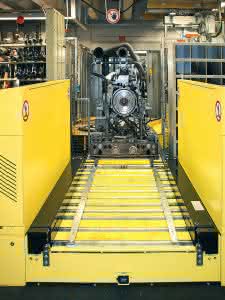
Although the new automatic vehicles travel at 0.6 m/s slower than their predecessors, the MLR AGVs achieve a higher throughput rate. Daniel Wittayer explains: "On the one hand, higher speeds are hardly noticeable in terms of time on the short routes. Secondly, we have made the driving strategies more intelligent. In the past, the vehicles had to leave the course to have their nickel-cadmium batteries recharged at a charging station. Today, charging takes place via charging contacts in the floor, which we installed along the route as part of the conversion. This saves an enormous amount of time and increases availability." In addition, the project manager continues, the AGVs drive in a route-optimized manner, and they also save travel time by going into a waiting position shortly before a bottleneck destination in order to reach the specified location more quickly. "After all, we run double cycles as often as possible to avoid empty runs," says Daniel Wittayer. "An engine is only brought to the test stand when another one can be picked up." MLR determined these strategies in advance during the planning phase together with the experts from Deutz using simulations.
There is a simple reason why the new MLR vehicles are not equipped with optical or laser-supported safety systems, but with a tactile system, namely soft bumpers at the front, rear and sides: "This spatially dense driving behavior on areas that are also used by the employees would often lead to unintentional vehicle stops with optical safety systems," Daniel Wittayer describes the situation. "Another advantage is the low sensitivity to soiling of tactile safety systems. The low speed of the AGVs means that employees are adequately protected."
Since the days after Whitsun 2015, the new AGV has been working under full load and to Deutz's satisfaction, as Alfred Jaeger, head of the test bay, confirms. "MLR was the right choice and impressed us with its technology and price."
Wolfgang Degenhard


You might also be interested in
Outdoor AGV networks production and logistics
An international company in the plastics industry is automating its intralogistics at its German site with a solution from ek robotics. A specially developed vehicle model from the Out Move series, an outdoor AGV, is being used.
 read more...
Transport systems for automated material flow
The Leo transporters from Bito make it easier for users to get started with the automation of material processes, which is possible from 20,000 euros. The system is a flexible all-in-one complete solution that is ready for immediate use and can be...
read more...Automated logistics for the university hospital
As part of the new construction of the University Hospital of Reims (CHU), France, the hospital has taken a number of steps to improve the needs of its patients and the working environment of its employees.
read more...K.Hartwall: Topping-out ceremony for the German site
The topping-out wreath was raised at the new building in the TIP Innovationspark Nordheide in Buchholz near Hamburg on February 27: The new K.Hartwall plant will comprise approx. 3,500 m² of hall space and around 2,000 m² of office and social areas.
read more...Noerpel Group tests driverless high lift trucks
The Noerpel Group has tested driverless pallet trucks in one of its two logistics facilities in Giengen. During a four-week trial, two autonomous systems were used to transport goods within the warehouse.
read more...Supply and disposal of printing machines by AGV
Numerous companies rely on AGVs in intralogistics to increase efficiency and meet challenges such as the shortage of skilled workers. One such company is GGP Media GmbH in Pößneck, Thuringia.
read more...Sophisticated automation: AGV and cobot combined
On behalf of Krefeld-based Saurer Technologies, the engineering team from Project Automation & Consulting developed a solution for production logistics that combines AGVs and cobots.
read more..."Herbie" robot in the Körber portfolio
Carrybots, a specialist in mobile robotics, is a new partner in the Körber supply chain ecosystem. The aim of this collaboration is to strengthen the position of both companies in intralogistics. Herbie" enables robot-based goods-to-person processes.
read more...Demand-oriented load carrier transport
Efficient logistics with AGVs
Environmental awareness and the careful use of resources are becoming increasingly important. With advanced solutions, plant operators can significantly improve the ecological footprint of logistics processes.
read more...