

Cranes & Components
New magnetic crane, new possibilities
Magnetic cranes enable fast, safe and material-friendly work processes and have become indispensable in the steel industry. As the design of the magnet depends on the material properties, shape, size and weight of the load, magnetic lifting beams for holding the steel are usually custom-made. The corresponding crane system is also not available in the catalog: With the control system for the magnets and increased safety requirements, magnetic cranes are sophisticated special solutions.
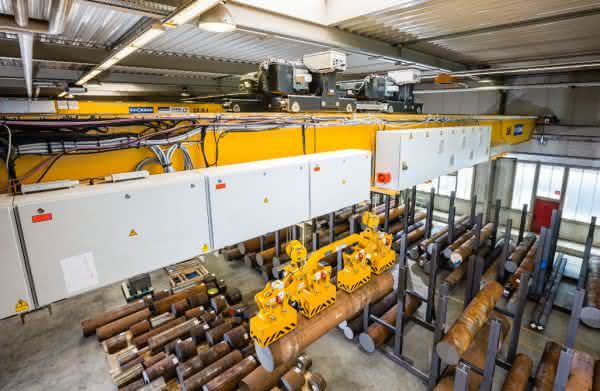
Dewald Stahlhandel sells and supplies round steel - throughout Europe. Dewald has 8,000 square meters of warehouse space at its headquarters in Pleidelsheim, Swabia. In order to expand further and increase its product range, the company needed more space. The fact that the neighboring hall became available at the end of last year was a lucky coincidence for the steel trader. With a further 1,000 square meters of space and two new magnetic cranes, Dewald can now lift individual pieces weighing up to 14 tons and offer larger diameters of cut steel bars. A crane builder was quickly found - Innokran, a partner of crane technology specialist Stahl CraneSystems, works in the building opposite. "We had high expectations of the new crane system and were pleased with the good advice we received from Innokran," says Thorsten Maier, one of Dewald's managing directors.
Crane made to measure
When steel bars are sawn, they become shorter. This is not surprising at first, but it does present the crane designer with a tricky task: long goods are usually lifted using a lifting beam. If this lifting beam is too long, short items cannot be lifted safely and cannot be deposited in a space-saving manner. However, if the lifting beam is too short, long bars cannot be lifted safely. If - as here at Dewald - offcuts and rods of shorter length are also to be transported, the use of a two-part lifting beam is recommended. This means that either all four magnets are available for long objects or two magnets are available at different heights.
Tandem as standard
The two hoists on the crane operate in tandem as standard: the crane operator places the magnetic lifting beam on the steel by radio remote control, activates the four electromagnets at the touch of a button and the load is safely suspended from the crane. If shorter pieces are to be picked up, the two parts of the lifting beam can be brought to different heights using the wire rope hoists and their magnets can be switched separately. This makes it possible to transport even short pieces of round steel.
Magnetic and safe
Magnetic cranes must meet high safety requirements. The magnetic force can be weakened during selective lifting. After lifting, the full magnetic force is then automatically switched on. A safety control system prevents the load from being released unintentionally. Reserve batteries on the crane bridge ensure that the load can still be held safely even in the event of a power failure.
Powerful crane technology
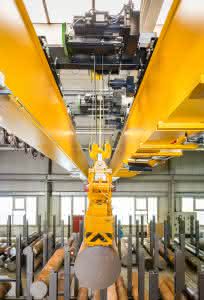
The crane works with two 8 t wire rope hoists from the SH series from Stahl CraneSystems and a magnet spreader beam from Scheffer. Frequency inverters on the hoist and travel motors ensure gentle, smooth movements. Thanks to them, even heavy steel bars can be placed. The controlled starting and braking reduces the time-consuming swinging of the load and reduces the impact on the crane runway and therefore the hall structure.
In addition to the 16-tonne magnet crane, a second, also newly installed crane with two SH wire rope hoists, each with a load capacity of 6.3 tons, and crane components from Stahl CraneSystems is also in operation in the hall. The 12.5-ton crane is also used to move the long round steel. However, the main task is to lift the cut steel disks out of the saw. The slices are placed on pallets and then loaded onto trucks using a forklift truck. A special single magnet, which is hooked into the hook of one of the wire rope hoists, is used for lifting. The power connection required for this is located on the load hook. As the steel disks are vertical after cutting but have to be transported horizontally, the special tilting magnet allows the load to be rotated in the air, which makes handling much easier for Dewald's employees.
Maximum lifting height
One of the tasks when designing the crane was to make the best possible use of the height of the hall in order to achieve the greatest possible lifting height. The criterion was to be able to unload bars with the largest possible diameter over the side of 40-ton articulated trucks. The crane was to use the maximum clear hall height to pass over the approximately four-metre-high side wall of the trucks in the top hook position. With a crane runway at 5.68 meters and a specified clearance height of 6.89 meters, Innokran only had the option of designing the crane as a double girder overhead crane.
One of Dewald's wishes was to use the double girder overhead crane to check the weight of the round steel when it was delivered. This required the most accurate weight measurement possible, which was not possible with the standard electronic load monitoring system. For this reason, Innokran implemented an additional, precise load measurement using two load measuring pins.
Technology in use
The installation of the crane system went quickly and smoothly and both cranes have proven themselves in daily operation. Thorsten Maier is satisfied: "We relied entirely on Innokran's expertise for the cranes, and that has paid off." There are already plans for the next expansion.


You might also be interested in
Crane retrofit in Emmerich
In the inland port of Emmerich, Tsubaki Kabelschlepp has overhauled the cable routing of a container gantry crane belonging to Contargo Rhein-Waal-Lippe. A pre-assembled Totaltrax solution was used, which the experts for energy chain systems...
 read more...
For drumming and towing - cables that pull along
With the Reeltec and Festoontec product series, TKD Kabel offers a portfolio of robust cable solutions for cranes and hoists. The specialist for application-oriented cable solutions thus also supports the increasing digitalization and automation of...
read more...Crane retrofit in Emmerich
In the inland port of Emmerich, Tsubaki Kabelschlepp has overhauled the cable routing of a container gantry crane belonging to Contargo Rhein-Waal-Lippe. A pre-assembled Totaltrax solution was used, which the experts for energy chain systems...
read more..."Customer awareness of environmental issues is increasing"
What trends and developments are there in the industry when it comes to green logistics? Experts provide insights: Christian Heid is Managing Director, SWF Krantechnik.
read more...New standards in lifting technology and material handling
Crane technology manufacturer SWF is now embracing digitalization and networking with a vengeance. Intelligent control aids make work safer and easier.
read more...Next generation electric wire rope hoist
SWF Krantechnik, supplier of components for industrial cranes and hoists, presented its new product innovationsto a broad specialist audience for the first timeat LogiMAT.
read more...Premieres for wire rope hoist and chain hoist
Rope hoist, chain hoist, Demag KBK light crane system: Demag will be presenting new products in each of the three product areas at Logimat.
read more...Crane technology: Konecranes presents solutions for material handling
Konecranes will present its latest Industrial Service and Equipment products at Logimat. Konecranes has pioneered safer, more productive and more sustainable material handling equipment.
read more...Starting signal for the intralogistics trade fair
The annual event opened its doors to trade visitors at 9 a.m. today. By midday, it was clear that there was a high level of interest from visitors, which corresponds to the fully booked halls.
read more...