

Cranes & Components
Lifting technology with explosion protection: insight into expert work
In potentially explosive industrial areas such as LNG plants, hoists and crane systems in particular, which are only used on the tanks for maintenance purposes, must function reliably and safely even after long periods of inactivity. This guarantees the necessary level of quality. Stahl CraneSystems is one of the world market leaders in this field.
Stahl CraneSystems was one of the first manufacturers to develop explosion-protected lifting technology at the end of the 1920s. This is always used when the hoists pose a risk of a potential ignition source in an explosive atmosphere. In many branches of industry, the risk of explosion is very high and can only be reduced by explosion-proof technology.
Explosion protection began in the mining industry. However, explosive atmospheres can also occur in other branches of industry, for example in the chemical and petrochemical industry, the shipbuilding industry or the energy supply sector. Electrical equipment used in explosive atmospheres must be designed in such a way that it does not become a source of ignition. To meet the requirements of the safety directives, Stahl CraneSystems has developed one of the world's largest product portfolios of explosion-protected lifting and crane technology. This is often used in the explosion-protected areas of LNG plants.
How is explosion protection implemented?
Neither standard nor Ex appliance boxes can prevent gases from entering the enclosure. Penetrated gas can be ignited by an ignition source inside the enclosure. Flameproof enclosures are therefore designed so that the ignition cools down and extinguishes via the threaded gap or the flat gap on the lid.
Stahl CraneSystems began developing explosion-proof cranes and control systems in 1926. A lot has happened technically since then. However, the mode of operation and importance of explosion protection have not changed. Stahl CraneSystems' explosion-protected control systems are predominantly designed in the "flameproof enclosure" and "increased safety" types of protection. The difference between standard control enclosures and enclosures in flameproof design for Zone 1 is the more stable and solid design.
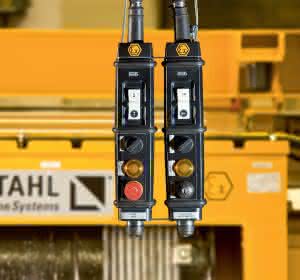
Installation materials such as cables, cable glands and cable entries must also comply with the standards and directives and be tested and certified accordingly. With the ATEX Product Directive 2014/34/EU (ATEX 95) and the ATEX Operator Directive 1999/92/EC (ATEX 137), the European Community has created the basis for uniform European explosion protection. Both directives are covered by Stahl CraneSystems products. In addition to the safe cast aluminum housing, most hoists are fitted with a second, separate housing as a terminal box made of sheet steel or stainless steel. Both enclosures are connected via explosion-proof cable bushings.
Use in Finland: Explosion protection in icy cold conditions
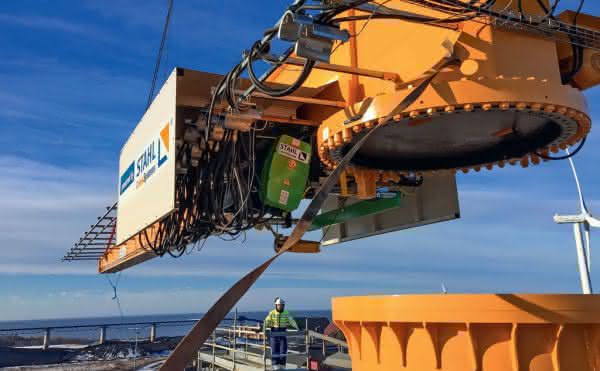
In 2015, the engineers at Stahl CraneSystems set themselves the challenge of developing an LNG maintenance crane on the icy coast of Finland. In March 2016, the first Finnish LNG tank went into operation in the port and industrial city of Pori. The crane on the tank is used whenever the pump needs to be lifted out of the LNG tank and serviced. This process has to be carried out up to five times a year. The pump, which pumps the -164 to -161°C cold liquefied natural gas into a pipe system, has to be lifted out of the 35 meter high tank and transported outside for maintenance work. The extreme conditions in the tank require special ropes that are firmly connected to the liquefied natural gas pump and are permanently in the tank.
For maintenance work, these ropes are attached to the rope drum and the hoist. Stahl CraneSystems uses a Boss Exn 32-16 slewing jib crane (Vetter Krantechnik) for this purpose. A modified SH 50 ex wire rope hoist with a lifting height of 46 meters is used. The lightweight LNG slewing jib crane is an invention of Stahl CraneSystems Spain, which is an alternative to the classic LNG hoists under certain conditions.
Intelligent gearbox arrangement
The area above the LNG tank is divided into different safety zones depending on the explosion risk assessment. In Pori, the highest risk zone 1 was limited to just two meters above the tank lid. According to this definition, individual elements of the crane were inside this zone, while others were outside it. The technicians and engineers took advantage of this division and produced a special solution: They relocated all of the hoist's electrical components to the main power box located outside Zone 1. The control system, crane operation and power supply could be relocated for applications in Zone 2 in accordance with EC Directive 94/9EG (ATEX 95). In this way, it was possible to dispense with an explosion-protected control box and provide protection with a single enclosure. The lower weight of the wire rope hoist had a positive effect on the design of the slewing crane. The inside of the explosion-proof housing and the motor have to be monitored by temperature sensors in the Finnish winter. Up to -29°C outside temperature, the housing is heated and the crane can operate without restrictions. However, if the temperature falls below this point, the system switches off automatically for safety reasons.


You might also be interested in
Winner material flow PRODUCTS OF THE YEAR 2023
Conductix-Wampfler: ChargeLine 0865
Two-pole conductor rail segments for efficient opportunity charging of shuttles, suitable for thousands of cycles per day.
 read more...
Hermann Grewer celebrates his 80th birthday
Hermann Grewer, Honorary Chairman of the North Rhine-Westphalia Transport and Logistics Association (VVWL) and Honorary President of the German Road Haulage, Logistics and Disposal Association (BGL), celebrated his 80th birthday on June 6.
read more...Well chilled for sure
V-Zug Kühltechnik AG, developer and manufacturer of refrigeration appliances and part of the successful V-Zug Group, has set up a new production facility for refrigerators of all heights and dimensions at its Swiss site in Sulgen.
read more...Advantageous automation of small parts warehouses
The RSX1 shuttle system will be at the center of Rocketsolution's presence at this year's Logimat trade fair.
read more...Reduced energy requirements in the high-bay warehouse
One of Germany's leading premium car manufacturers is already focusing on energy efficiency in the production of its new SUV model with electric drive. The storage and retrieval machines in a high-bay warehouse at the production site have been...
read more...Low lift pallet truck for light duty applications
Clark has launched a new low lift pallet truck with the model designation LWio15 for light transport tasks. The truck has a load capacity of 1500 kg and is suitable for short distances in goods distribution, production or warehousing.
read more...Internationalization as an opportunity
E-commerce is in a state of flux. Changes in purchasing behavior and procurement problems are keeping e-commerce retailers busy. Logistics plays a decisive role in the overall online shopping experience.
read more...Fulfillment Center for Frisco.pl
Polish eGrocery specialist and TGW deepen partnership
TGW is building a highly automated fulfillment center for Frisco.pl in the Polish capital Warsaw. This is the second project in a row that the two companies have implemented together.
read more...Which world will it be in 2023?
Michael Schreckenberg teaches at the University of Duisburg-Essen as Professor of Physics of Transport and Traffic. Once a year, he addresses the readers of materialfluss, formerly LT-manager, with a critical and humorous expert article on transport...
read more...